
Tarrant Parole and Probation Compared
Parole is a conditional release from imprisonment before the sentence has fully expired. The Texas Board of Pardons and Paroles makes the release decision, while the TDCJ Parole Division supervises the person in the community. Mandatory supervision is also a prison-release category, but eligibility and the decision process depend on the offense and sentence dates. Probation is a sentence or court-ordered placement in the community under Code of Criminal Procedure chapter 42A. In Tarrant County, the court retains authority over that case and the county community-supervision department carries out supervision.
| Question | Parole | Probation |
|---|---|---|
| Who orders it? | Texas Board of Pardons and Paroles after prison review | The sentencing court in the criminal case |
| Who supervises it? | TDCJ Parole Division | Tarrant County Community Supervision and Corrections Department |
| Best status source | TDCJ IVSS, TDCJ status information, and the assigned parole office | The case docket, sentencing order, and county supervision office |
| How does it end? | Discharge, revocation, or sentence expiration recorded by TDCJ | Court discharge, completion, early termination, or revocation |
Neither label proves that a person is currently reporting. A judgment may mention probation that was later completed or revoked. A TDCJ record may show a prior parole period that ended in discharge. Use a current agency result and the underlying order instead of relying on an old docket entry or a third-party summary.
Verify Tarrant Post-Release Supervision
Start with the custody path. Someone released from a TDCJ prison or placed at the Fort Worth Transitional Center should be checked through state systems. Someone sentenced directly to community supervision in a Tarrant County court belongs on the local court and probation path. A county-jail book-out by itself does not identify the ongoing supervisor.
- Collect the full name, date of birth, TDCJ or state identification number when available, and the Tarrant County case number.
- For parole, search TDCJ IVSS. Compare identifiers, offender status, release history, facility, and supervision information rather than matching on a name alone.
- Review the official parole review result guidance if a decision code appears. A favorable vote is not the same as completed community release.
- For probation, locate the case through the Tarrant County public court portal and read the judgment, conditions, later motions, and discharge or revocation orders.
- Contact the responsible agency using the official directory. Ask what information can be released and do not assume staff can disclose a participant's schedule or residence.
- If custody status may have changed, use Texas IVSS-Counties or TDCJ IVSS for notifications, then confirm the event with the originating office or court record.
A negative name search is not conclusive. Spelling, identifiers, sealed records, a move between systems, or a completed term can affect results. The Tarrant County released inmate search guide explains how to pair a custody record with a court disposition or receiving-agency record.
Tarrant Parole Office Routing
TDCJ publishes a Region II directory with Fort Worth District Parole Office I at 3628 McCart Avenue and Fort Worth District Parole Office II at 4836 Carey Street. Specialized functions and caseload assignments can change which office holds a particular record. Use the current directory rather than selecting an office only from the person's home address.
Fort Worth I: 3628 McCart Avenue, Fort Worth, Texas 76110
Fort Worth II: 4836 Carey Street, Fort Worth, Texas 76119
Official Region II office directory
For county probation, use the Tarrant County court case to identify the proper community-supervision unit. Court clerks preserve the judgment and later orders, while supervision staff administer reporting and conditions. Those roles are complementary: the docket establishes what the judge ordered; the department addresses current administration within lawful disclosure limits.
Tarrant Supervision Conditions and Violations
Conditions can include reporting, approved residence, travel limits, treatment or programming, fees, substance restrictions, and offense-specific requirements. The controlling list is the signed court order for probation or the official certificate and Parole Division instructions for parole. General summaries cannot establish the conditions in one person's case.
A reported violation does not automatically prove revocation. For probation, the state may file a motion and the court decides the result. For parole, TDCJ and the Board use their own warrant and revocation procedures. An absconder label generally signals loss of contact or failure to report, but the current warrant and agency record should be checked. Do not approach or attempt to detain anyone based on an online result. Contact the agency or law enforcement if immediate safety is involved.
Texas IVSS notifications can report certain custody or supervision changes. They are alerts, not certified dispositions. Read whether the event is a release, transfer, supervision change, or return to custody, retain the agency and time shown, then verify it in the parole record or court file.
How Tarrant Supervision Ends
Parole may end when TDCJ records discharge or sentence expiration, or it may be interrupted by revocation and return to custody. Probation may end on successful completion, early termination ordered by the court, revocation, or another final order. Reaching an anticipated date does not establish completion if a warrant, tolling issue, amended order, or unresolved proceeding remains.
For durable proof, obtain the final source record. TDCJ IVSS can show release and status history, while TDCJ records can answer a targeted request. In a probation case, the clerk's docket and signed discharge order are stronger than a verbal report or stale portal summary. Texas Government Code chapter 552 applies to executive-agency public records subject to exceptions, but judicial records follow court and clerk access rules. Sealed, nondisclosed, juvenile, medical, and other protected material may be unavailable.
Tarrant Parole Review Process
The Texas Board of Pardons and Paroles uses an administrative file review by a three-person panel. The official process describes an institutional parole officer summary and sequential voting; two concurring votes form a majority. Panel members do not conduct a formal public case hearing, and ordinary Board business meetings are not a calendar of named prisoners awaiting decisions.
Person-specific timing appears as a Next Review Date in TDCJ or Board status information. TDCJ describes cases being pulled about six months before an initial eligibility date and about four months before later reviews. Results use official vote codes. Approval codes include FI variants and RMS, while denial codes include NR, SA, and DMS variants. Preserve the exact code and consult the official vote-option descriptions. A next review date is not a release date, and eligibility under Government Code section 508.145 is not entitlement to parole.
Tarrant Post-Release Reentry Services
Tarrant County has a practical service network separate from supervision enforcement. TCSO says requested reentry classes are offered at the Corrections Center and Green Bay Jail, with roughly 30 to 40 participating organizations providing 50 to 60 resources. Inmate Services and the Chaplain can be reached at 817-884-3088. These programs may help with transition planning, but participation does not establish parole or probation status.
After prison release, the county's First-Stop Center at 2300 Circle Drive, Suite 2301, provides orientation and navigation for returning adults. The Tarrant County Re-entry Program is a service route rather than a supervision office. Its role is especially important when the formal record answers whether a person is supervised but not where that person can obtain practical help.
Read Tarrant Parole Status Carefully
TDCJ status information can combine several dates and labels that answer different questions. The intake and release history records custody transactions. Offender status can indicate incarceration, release, discharge, or supervision. Parole Review Information may show a past decision date, its official code, and a future review date. Location may be a prison, a release destination under processing, or a supervision setting. Compare the complete record instead of lifting one favorable field out of context.
The TDCJ IVSS portal illustrates the state status route used for prison and parole records.
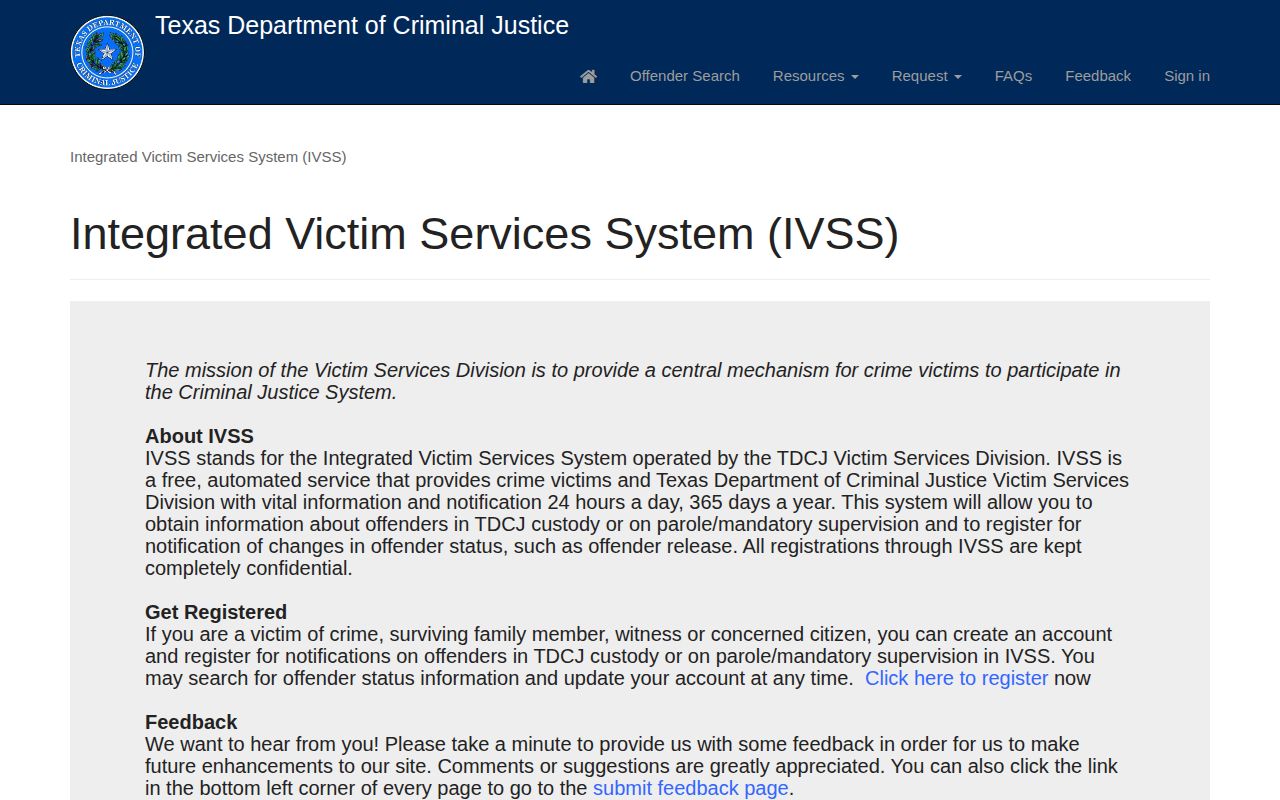
The portal image is useful for recognizing the official service, but a live record still has to be matched by identifiers and confirmed when the outcome matters. A result showing release from TDCJ does not exclude a new county, federal, or immigration custody event.
The official Region II parole directory is the source for current Fort Worth office routing.
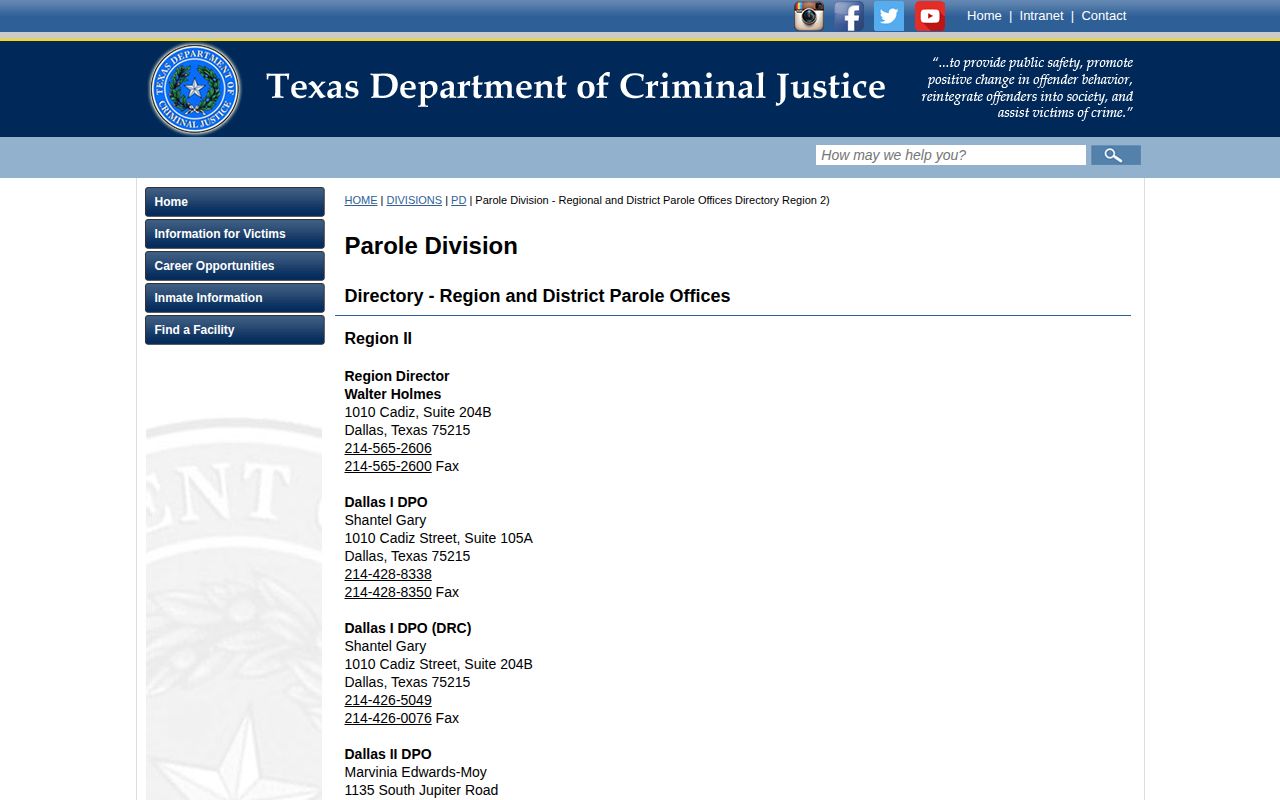
The directory helps distinguish a verified agency contact from an old address copied elsewhere. It does not reveal a person's private reporting schedule or prove which specialized caseload currently has the file. Use it to reach TDCJ, provide the identifying number, and ask for the proper official status route.
County probation presents a different record problem. A public docket may show the original placement, later modification motions, violation allegations, and a final order. Allegations do not prove the court's ruling. Read the signed order and its date. If the case is unavailable online, contact the appropriate clerk using the case number. Class A and B misdemeanor records generally route through the County Clerk, while felony matters route through the District Clerk.
Tarrant Supervision Record Limits
Public records can identify an agency, legal status, decision, and dates, but they do not make every supervision detail public. Residence plans, treatment information, victim information, medical records, personal contact details, and operational reporting schedules may be restricted. A public-facing office directory is a routing tool, not permission to seek private details from staff or third parties.
Government Code chapter 552 contains exceptions and works alongside other confidentiality laws. Court records follow judicial access rules rather than the executive-branch Public Information Act. Expunction and nondisclosure can also affect availability. Keep a request narrow: identify the person and case, name the status or final document sought, and ask for segregable public portions. This produces a more reliable answer than requesting a broad history that may be delayed, withheld, or confused with someone of the same name.
Verification is strongest when custody, supervision, and court sources agree. If they do not, record each source's date and exact language and ask the responsible custodian to reconcile the discrepancy. Do not convert an unresolved difference into a claim that supervision ended.