
Tarrant Projected and Actual Release Dates
TDCJ defines projected release date as the date calculated from the maximum sentence using time credits and applicable eligibility rules. It can represent the earliest date among parole eligibility, discretionary mandatory supervision, or mandatory supervision, depending on the case. A scheduled release date appears when release processing has advanced and should be read with the scheduled release location. The actual release or discharge date records a completed custody event.
| Date | Source | What it establishes |
|---|---|---|
| Projected release date | TDCJ calculation from sentence and credit data | An estimate that can change; not a promise of release |
| Scheduled release date and location | TDCJ processing and audit | A stronger operational plan, expressly subject to change |
| Actual release or discharge date | Completed jail or TDCJ transaction | Departure from that custodian, paired with release type or receiving custodian |
A person awaiting trial in the Tarrant County Corrections Center has no fixed projected sentence date. Bond approval authorizes a possible release path but does not complete book-out. Another hold, processing, property return, transportation, or transfer can remain. Ask for the booking-specific TCSO book-out and disposition when the event has occurred.
Find Tarrant Projected Release Dates
Identify the system before searching. TCSO, TDCJ, federal custody, municipal detention, and transitional placement do not share one release calculator. The same person may move through several systems, and each departure proves only release from that custodian.
- Collect the exact name, date of birth, and any CID, SID, TDCJ, booking, or case number. Identifiers reduce false matches.
- For a current state prisoner, use the TDCJ current inmate search. It requires an exact last name plus at least a first initial, or a TDCJ or SID number.
- Open the detail record and read the location, offenses, projected release date, parole review information, and any scheduled release date and location. Do not treat a parole eligibility date as a release date.
- Use TDCJ IVSS for status, expected release information, intake and release history, and notification options. This path can help when the legacy current-only search no longer returns a released person.
- For a Tarrant County jail sentence, contact TCSO Records and the sentencing court. Ask for sentence start, jail credit, good-time treatment actually applied, calculated discharge, and the completed book-out record.
- Register for a custody alert, then verify the reported event with the jail, TDCJ, court, or receiving custodian. The VINELink inmate search guide explains the current Texas IVSS channels.
The Tarrant County released inmate guide covers the broader record trail. A court judgment establishes the sentence, while the custody agency calculates and records time served and release. When those sources appear inconsistent, request the underlying record rather than choosing the most favorable date.
Tarrant Release Dates and Good Time
Texas Government Code chapter 498, including section 498.003, governs TDCJ good-conduct time. The credit affects classification and eligibility calculations; it does not reduce the judicial sentence itself and does not guarantee release on the first eligible day. Credit may be forfeited through disciplinary action. Offense type, offense date, sentence structure, and statutory exclusions determine whether and how the credit matters.
Texas has no general rule that every prisoner serves 85 percent of a sentence. Government Code section 508.145 contains offense-specific parole formulas. For many cases associated with Code of Criminal Procedure article 42A.054 and Government Code section 508.149, a prominent formula requires actual calendar time, without good-conduct time, equal to one-half of the sentence or 30 calendar years, whichever is less, with statutory minimums. Other offenses have different rules, including particular 35-year provisions. A formula determines review eligibility, not a guaranteed release.
Mandatory supervision also needs careful labeling. For eligible cases, time credits may create eligibility, but post-1996 discretionary mandatory supervision still involves a decision. Parole is discretionary. Death and life-without-parole sentences are not parole eligible. Because legal treatment changes with the offense and date, no general calculator can safely replace the TDCJ record and governing statutes.
What Changes Tarrant Release Dates
A projected or scheduled date is a working result of the information then available. The change itself may be correct even when an older screenshot or letter shows another date.
| Factor | Possible effect | Where to verify |
|---|---|---|
| Disciplinary loss of good time | Changes credit and eligibility calculations | TDCJ classification and official record |
| Parole denial or later approval | Defers release or creates a conditional path | BPP result and exact vote code |
| Program or residence-plan requirement | Approval may exist before release logistics are complete | TDCJ and assigned parole office |
| Record audit or time-credit correction | Moves the calculation in either direction | TDCJ records or county sentencing record |
| Additional sentence or court amendment | Changes controlling authority or aggregate time | Sentencing court and custody agency |
| County, federal, or ICE detainer | May produce transfer instead of community release | Releasing and receiving custodians |
| Rescission or reconsideration | An earlier favorable parole action may change | Current BPP/TDCJ status |
Tarrant County participates in 287(g), and an ICE detainer can request notice before release and up to 48 additional hours for ICE to assume custody. A county-jail release record can therefore be accurate while the person remains detained elsewhere. The same caution applies to transfer to TDCJ, another county, or federal custody.
Confirm Tarrant County Release Dates
Texas uses two related notification paths. TDCJ IVSS covers prison and parole status. Texas IVSS-Counties covers participating county custody and court notifications, replacing the old Texas county VINE/VINELink workflow on September 1, 2025. Search by name or identifier, open the matching record, and select available call, text, or email notifications. Do not rely on obsolete instructions that promise a four-digit telephone PIN.
An alert establishes that a participating agency reported a status change. It does not prove that all holds cleared or that the person entered the community. Preserve the event wording, agency, and time. Then obtain the actual release date, release type, and receiving custodian from TCSO, TDCJ, or the court as appropriate.
Tarrant TDCJ Release Search Limits
The legacy TDCJ inmate search covers people currently incarcerated in TDCJ. If a name disappears after the expected date, the absence does not create a released-person archive and does not identify where the person went. TDCJ IVSS may show offender status and intake or release history, while a focused Public Information Act request can seek durable agency records.
The state also offers an inmate-information email route, but its published rules limit what can be supplied and say projected release dates can change without notice. Use one request per person and provide adequate identifying information. For a certified or consequential answer, ask the records custodian for the recorded disposition rather than relying on a current-only search result.
The distinction matters at the Fort Worth Transitional Center. Placement there can be a supervised residential stage, not final discharge from the sentence or parole term. Confirm through TDCJ Parole Division, TDCJ IVSS, and the assigned office instead of treating the facility address as proof of unrestricted release.
Read Tarrant TDCJ Release Records
A current TDCJ detail record should be read as a set. Match the name and identifier first. Then compare current location, controlling and noncontrolling offenses, sentence dates, projected release date, parole review information, and any scheduled release date and location. A projected date next to a future review does not mean the Board has approved release. A favorable Board code may still carry a program, date, or release-plan condition. A scheduled location can also change without notice.
The TDCJ IVSS portal provides the state offender-status and notification route documented for Tarrant County searches.
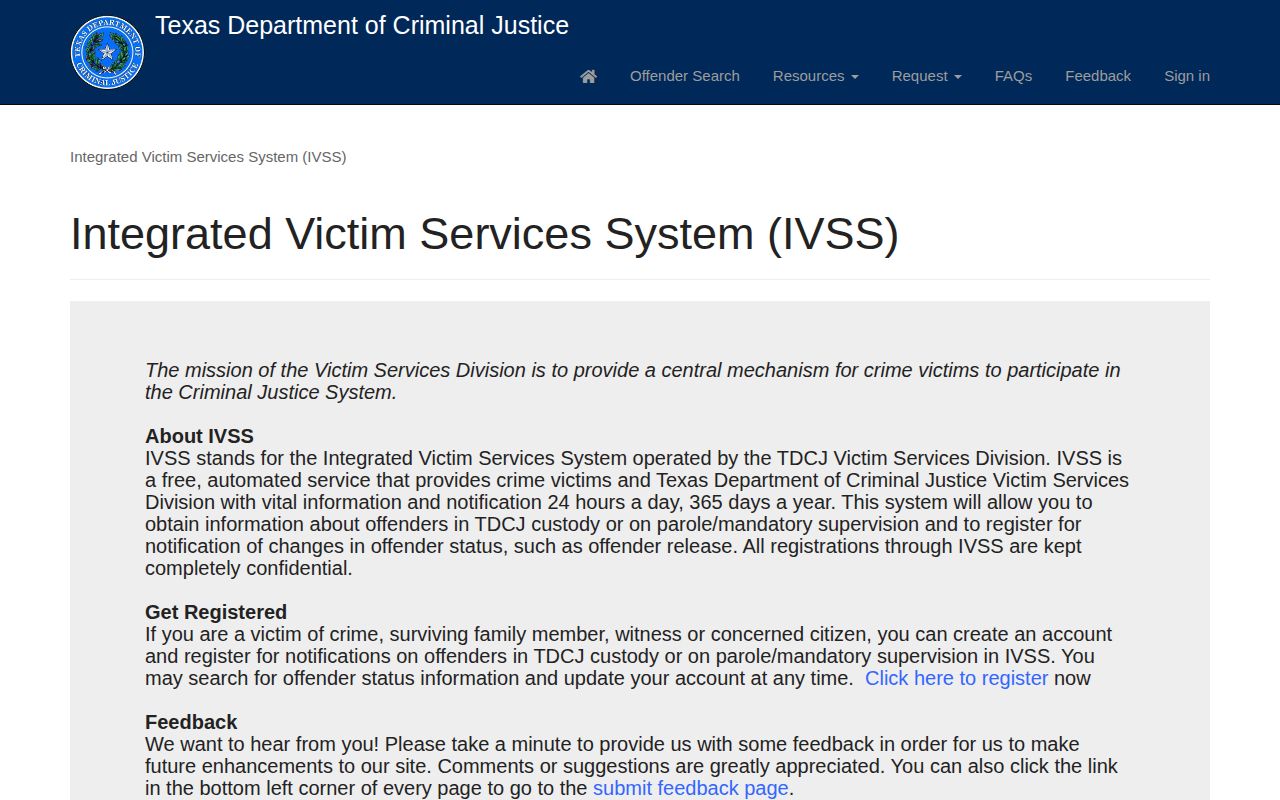
This official interface can expose status and number-history intake or release fields after a careful identifier match. Because dynamic systems can change labels or suppress no-longer-current records, save the relevant agency wording and follow with a targeted records request when lasting proof is needed.
Tarrant County Release Needs Two Records
For a sentence served in Tarrant County Jail, the court and Sheriff answer related but distinct questions. The judgment states the term imposed and credits ordered by the judge. TCSO applies the custodial record, including actual admission, jail credit in its system, local good-time treatment, and book-out. A projected date written down before final processing can become stale if the court amends the judgment or the custody record is corrected.
Ask the clerk for the signed judgment, sentence, and any later amended order. Ask TCSO Records for the booking-specific incarceration and release transaction, including book-in, book-out, disposition, and transfer destination if public. TCSO's Letter of Incarceration is a published personal-document option for a released individual, but it has its own identity and in-person requirements and is not the same as a general third-party records request.
Municipal confinement also stays in its own silo. Fort Worth may release a person from temporary detention before county booking. Keller Regional generally holds people fewer than 72 hours before release or transfer. Arlington and Mansfield maintain their own custody operations. If no TCSO booking exists, return to the arresting city and court instead of trying to force a county-jail calculation onto a municipal event.
Tarrant Parole Review and Release Dates
The Texas Board of Pardons and Paroles reviews files through three-person panels, not a formal public hearing for the prisoner. TDCJ describes cases being prepared months before the initial eligibility date and later review dates. The Next Review Date therefore tells when another decision may be considered, not when custody will end.
Preserve the exact vote code. FI variants and RMS are approval categories with defined instructions; NR, SA, and DMS variants are denial categories. A colloquial description such as “deferred” can erase the actual condition or timing in the Board's code. Approval can also be reconsidered or rescinded under Board rules. Verify the current result shortly before any expected release and again after the reported custody event.
When a date changes, compare records by retrieval date. An older printed result may have been correct when issued but superseded by a later audit, Board action, or hold. The most recent official field is the operational starting point; the completed release transaction remains the final proof.